
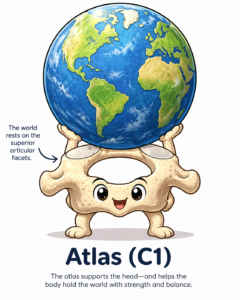
The Atlas (C1) is the first cervical vertebra located at the top of the spine, directly beneath the skull. It supports the head and protects the brainstem, making it one of the most neurologically important structures in the body.
Unlike other vertebrae, the atlas:
- Has no disc and no vertebral body
- Functions as a ring-shaped bone
- Allows for head movement, balance, and neurological communication
When the atlas becomes misaligned (also known as a subluxation), it can influence the nervous system, circulation, and structural balance of the entire body.
What Happens When the Atlas Is Out of Alignment?
When C1 shifts out of its optimal position, it may affect:
- The C1 nerve root
- The brainstem environment
- The dural system (central nervous system covering)
- Blood flow and lymphatic drainage
This is why symptoms can feel systemic, not just local.
C1 Nerve Root Function: Muscles, Skin, Organs & Glands
Important Clarification:
The C1 nerve root is primarily motor, meaning it controls muscles—not organs or skin in the traditional sense.
💪 Muscles Innervated by C1
The C1 nerve (via the suboccipital nerve) innervates:
- Rectus capitis posterior major
- Rectus capitis posterior minor
- Obliquus capitis superior
- Obliquus capitis inferior
These muscles:
- Stabilize the head
- Control fine movements
- Provide proprioceptive feedback to the brain
C1 also contributes to:
- Geniohyoid
- Thyrohyoid
👉 Supporting swallowing and throat coordination
🧍 Skin (Dermatome)
- C1 typically has no distinct dermatome
- However, dysfunction may refer discomfort to:
- The occipital (back of head) region
🫀 Organs & Glands
Direct innervation:
❌ None
However, due to its proximity to the brainstem and vagus nerve, atlas misalignment may influence:
- Heart rate regulation
- Digestive function
- Stress response
- Hormonal balance (via hypothalamic signaling)
The atlas is directly connected to the dural tube, the protective membrane surrounding the brain and spinal cord.
Key Attachments:
- Base of the skull (occiput)
- C1 and C2
- Extends down to the sacrum
When Dysfunction Occurs:
- Tension can travel throughout the entire system
- This may affect:
- Cranial rhythm
- Spinal mobility
- Nervous system regulation
👉 In craniosacral therapy, this is where we often feel:
- Restrictions
- Still points
- Stored tension patterns