The Science of Generational Healing: What Epigenetics Actually Shows

By: Dr. Mary Nochimson

For many years, people assumed inheritance was simple: genes are passed down, and that’s the end of the story.

Modern biology tells a more nuanced — and hopeful — truth.

Your DNA sequence may be inherited, but how genes are expressed can change based on life experience.

This field of study is called epigenetics.

“Epi” means above or on top of genes. Epigenetic mechanisms act like biological switches that turn genes up, down, on, or off depending on environmental input — including stress, safety, nutrition, and emotional experience.

In other words:

Life experiences can leave measurable biological signatures
that influence how the body functions — sometimes across generations.


How experience becomes biology

The most studied epigenetic mechanisms include:

  • DNA methylation — chemical tags that reduce gene activity

  • Histone modification — structural changes that affect gene accessibility

  • Stress hormone regulation pathways — especially involving cortisol and the HPA axis

These systems are highly responsive to environmental conditions, particularly during sensitive developmental periods — pregnancy, infancy, and early childhood.

When stress is chronic or overwhelming, the body adapts biologically.
When safety and regulation are present, the body adapts biologically.

Both directions matter.


Landmark research on stress and inherited biological patterns

1. Early caregiving shapes lifelong stress regulation

One of the most influential research programs in epigenetics comes from neuroscientists Michael Meaney and Moshe Szyf.

They found that rat pups receiving high levels of nurturing maternal care developed healthier stress responses, while those receiving low nurturing showed heightened stress reactivity throughout life.

The difference was not genetic — it was epigenetic.
Maternal behavior altered gene expression in brain regions that regulate stress.

Even more striking:
When nurturing patterns changed, epigenetic patterns changed too.

This demonstrated that environment can biologically “program” stress regulation — and that programming is modifiable.

Key research:
Meaney, M. J., & Szyf, M. (2005). Environmental programming of stress responses through DNA methylation. Dialogues in Clinical Neuroscience.


2. Trauma exposure can affect the next generation’s stress biology

Studies of human populations exposed to extreme trauma provide additional insight.

Research on children of Holocaust survivors found measurable differences in cortisol regulation compared to controls, suggesting altered stress-response systems associated with parental trauma exposure.

Importantly, these findings indicate that severe stress experiences may influence biological regulation patterns in offspring — not through genetics alone, but through epigenetic pathways.

Key research:
Yehuda, R., et al. (2016). Holocaust exposure induced intergenerational effects on FKBP5 methylation. Biological Psychiatry.


3. Prenatal environment shapes long-term health outcomes

The Dutch Hunger Winter of 1944–1945 created a natural experiment in prenatal stress exposure.

Individuals exposed to famine in utero showed persistent epigenetic changes decades later — particularly in genes involved in growth and metabolism. They also displayed higher rates of metabolic and cardiovascular conditions in adulthood.

This demonstrated that early environmental conditions can produce long-lasting biological effects measurable across the lifespan.

Key research:
Heijmans, B. T., et al. (2008). Persistent epigenetic differences associated with prenatal exposure to famine. Proceedings of the National Academy of Sciences.


4. Learned fear responses can influence offspring biology (animal research)

In a widely discussed study, mice conditioned to fear a specific odor produced offspring who showed heightened sensitivity to that same odor — despite never being exposed to the original conditioning experience.

Researchers observed epigenetic changes in sperm associated with sensory processing pathways.

While animal findings cannot be directly generalized to humans, they provide powerful models for understanding biological transmission of environmental learning.

Key research:
Dias, B. G., & Ressler, K. J. (2014). Parental olfactory experience influences behavior and neural structure in offspring. Nature Neuroscience.

The most important takeaway: epigenetic patterns are dynamic

Perhaps the most hopeful finding across epigenetics research is this:

Epigenetic changes are not fixed. They are responsive.

Supportive environments, stress reduction, social connection, nurturing caregiving, and nervous system regulation all influence biological functioning.

Protective factors can buffer risk.
Safety can reshape stress response.
Healing environments can influence gene expression.

This means biology is not destiny.


Why this matters for generational healing

If stress can shape biological patterns…

Then safety can shape them too.

If trauma can influence future regulation…

Then healing can influence future regulation.

When a person learns to regulate their nervous system, process emotion, and experience sustained safety, they are not only improving their own well-being — they may also be altering the biological environment that shapes the next generation’s development.

From a scientific perspective, generational healing is not mystical language.

It is consistent with what we know about:

  • developmental neurobiology

  • stress physiology

  • epigenetic responsiveness

  • intergenerational caregiving patterns


What science and wisdom traditions both recognize

Passover remembers liberation across generations.
Easter remembers restoration across generations.
Epigenetics studies how lived experience shapes biological inheritance across generations.

Different languages.
Same direction.

Human beings are not biologically isolated individuals.
We are living continuations of environments, relationships, and experiences.

And that means something profoundly hopeful:

Every moment of regulation, safety, repair, and compassion
is not only personal healing —
it is biological contribution to the future of humanity.


References (peer-reviewed research)

  • Meaney, M. J., & Szyf, M. (2005). Environmental programming of stress responses through DNA methylation. Dialogues in Clinical Neuroscience.

  • Yehuda, R., et al. (2016). Holocaust exposure induced intergenerational effects on FKBP5 methylation. Biological Psychiatry.

  • Heijmans, B. T., et al. (2008). Persistent epigenetic differences associated with prenatal exposure to famine. PNAS.

  • Dias, B. G., & Ressler, K. J. (2014). Parental olfactory experience influences behavior and neural structure in offspring. Nature Neuroscience.

Passover, Easter & Humanity’s Invitation to Heal

By: Dr. Mary Nochimson

March has a particular kind of “charge” to it.

It’s spring (new life), but the world still feels tender. People are carrying a lot—personally, politically, financially, emotionally. And right as we reach the end of March, two of the most powerful healing stories in human history come into view:

  • Passover begins at sundown on Wednesday, April 1, 2026 and continues through Thursday, April 9, 2026.

  • Easter Sunday is April 5, 2026, with Palm Sunday on March 29, 2026 (meaning this week is the threshold right before Holy Week).

So March Week 4 isn’t just another week. It’s a crossroads week—a doorway.

A week to ask: How do we come out of bondage—together? How do we heal as a humanity?


The shared thread: freedom after pressure

Passover: freedom that begins in the subconscious mind

Passover is the story of liberation—leaving Egypt, leaving oppression, leaving “not-enough-ness.” Not just as a historical moment, but as a recurring human experience: the moment you realize, I can’t live like this anymore.

That’s trauma language, too.

Because trauma isn’t only “what happened.” Trauma is also:

  • the stuckness

  • the shutdown

  • the hypervigilance

  • the feeling of “I can’t get out,” even when the door is open

Passover reminds us: freedom is possible, but it often starts with a choice… and then a practice.

Easter: life that returns after loss

Easter carries the central Christian story of death and resurrection—life returning after devastation.

Whether you hold that as theology, history, metaphor, or mystery, the emotional arc is undeniable:

  • grief

  • surrender

  • love that doesn’t abandon

  • and then… something rises

That’s also nervous-system truth:

Healing rarely looks like “powering through.”
Healing looks like coming back to online, back to reality, back inside our bodies.


A quick (honest) history bridge: how these holidays intertwine

Historically, early Christians connected Jesus’ final days with the Jewish festival cycle, and there’s a long conversation in scholarship and tradition about how exactly those meals and dates align.

  • The Gospels place Jesus’ last week in Passover season, and the Synoptic Gospels describe the final meal in Passover terms—yet many scholars note that the Seder as practiced today developed later, so the “Last Supper = modern Seder” idea is debated.

  • Over time, Christians argued about whether to celebrate Easter in direct alignment with Passover dates or always on a Sunday. This became part of what’s known as the “Easter controversy,” and later church councils helped standardize how Easter’s date is set.

What are your thoughts?


Healing as a humanity

When I zoom out, Passover + Easter together form a healing map:

1. Name what enslaves you (without becoming it)

“Egypt” can be:

  • fear cycles

  • inherited trauma

  • addiction patterns

  • nervous system dysregulation

  • resentment that keeps looping

  • the belief that you’re powerless

This week, try this gentle truth:

“I can honor why this pattern began… and still choose to outgrow it.”

2.  Practice release in the body, not just in the mind

So many people try to “think” their way into peace.

But the body keeps receipts.

If you want to heal at a humanity level, we need more subconsciously aligned humans—not just informed humans.

THIS WEEK,  let your practices be somatic:

  • a 10-minute walk after dinner

  • humming (vagus nerve support)

  • warm bath + slow exhale

  • gentle craniosacral / bodywork / breathwork

  • prayer or meditation that feels like safety, not pressure

3) Choose “unleavened” honesty

In Passover, leaven is removed—symbolically clearing what puffs us up or distorts what’s true.

For modern healing, I read that as:

  • clear out what’s performative

  • come back to what’s real

  • stop pretending you’re fine when you’re burnt out.

This is the week for clean truth:

“Here’s what I actually feel.”
“Here’s what I actually need.”
“Here’s what I’m ready to release.”


A gentle closing thought (and a real invitation)

This season isn’t asking you to be perfect. It’s asking you to be awake.

Passover says: You can leave.
Easter says: You can rise again.

And humanity?
Humanity heals one human being at a time.

If you want support, this is exactly the kind of season where nervous-system care helps everything land more deeply—craniosacral therapy, chiropractic nervous-system work, gentle hypnotherapy, and simple practices you can actually keep.

And if you’re a parent: bedtime is a power portal. (That’s why I wrote A Hypnotherapy Bedtime Story—because healing doesn’t have to be hard to be real.)

You don’t have to carry this season alone.

Craniosacral Therapy Education

Do you live with chronic pain that never fully goes away?
Feel anxious or “on edge” for no clear reason?
Struggle with sleep, fatigue, or brain fog?
Find yourself overreacting in relationships — even when you don’t want to?
Sense that you’ve “done the work,” yet something still feels stuck?

If any of this sounds familiar, here’s an important truth:

It may not be in your head.
It may be in your nervous system.

Sometimes healing arrives not just through study — but through experience.

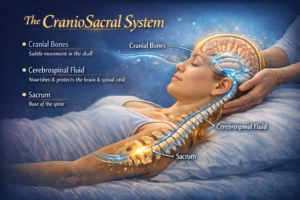
This past weekend, I immersed myself in a CranioSacral Therapy training inspired by the work of Dr. John Upledger. The experiences in that class were profound. I witnessed how gently supporting the craniosacral system can create deep shifts in the entire body — physically, emotionally, and energetically.

I left the weekend reminded of something powerful:

Our body never forgets, and our body never stops trying to heal.

And perhaps the most meaningful realization of all:

“…we must become the medicine ourselves.”

That is why CranioSacral Therapy is the topic this week — because once you feel its effects firsthand, you will understand why this work sits at the heart of true healing.

And this matters because:

Trauma is not only what happened to you — it’s what your body couldn’t fully process at the time.

How Unresolved Trauma Lives in Your Body.

When you experience stress, injury, emotional shock, or prolonged tension, your nervous system shifts into survival mode — fight, flight, or freeze. If that survival energy isn’t fully discharged, it becomes stored in your muscles, fascia, organs, and nervous system.

Over time, it may show up in ways you don’t always connect back to trauma.

Physically, you may notice: chronic pain or recurring tension, Headaches or migraines, jaw clenching or TMJ issues, digestive discomfort such as IBS, fatigue or difficulty sleeping, and even lead to Hormonal imbalances.

Emotionally, stored trauma can appear as anxiety or constant worr, emotional overwhelm, irritability, sudden mood shifts, feeling unsafe for no obvious reason, and difficulty calming after stress

Mentally when trauma remains unresolved, your mind may stay in protective mode resulting in those racing thoughts, brain fog, difficulty focusing, hyper-vigilance, negative self-talk, and feeling disconnected from yourself

In Your Relationships, unresolved trauma often shows up as overreacting to small triggers, difficulty trusting. fear of abandonment, emotional withdrawal, people-pleasing, and repeating unhealthy relationship patterns.

This is why healing trauma isn’t just about “talking it out.”, it’s about releasing the trauma on a subconscious SomatoEmotional level 

How HEALING happens with CranioSacral.

CranioSacral Therapy works directly with your mind and body’s deepest protective patterns. By gently releasing restrictions in the craniosacral system, your body can:

  • Shift from fight-or-flight into rest-and-repair.
  • Release stored tension from past injuries or emotional shock.
  • Enhance body awareness and connectedness.
  • Enhance emotional resilience.
  • Restore your natural self-healing rhythm

Many people describe sessions as deeply relaxing. Later, they notice changes they didn’t expect — improved sleep, calmer reactions, reduced pain, emotional and existential clarity, or simply feeling more like themselves.

That’s because CST doesn’t force healing.

It allows your body to finish what it once couldn’t.

At its core, trauma healing is about restoring safety in our mind, body and spirit, because when our body feels safe, unconditionally loved and accepted, our mind becomes clearer, your emotions soften our relationships improve and our physical symptoms often lessen.

This is why CranioSacral Therapy is such a cornerstone of the work I experience in my office. I meets you gently, respectfully, and powerfully — without pushing or overriding you. 

Because healing isn’t something done TO us.

It’s something WE DO!

If you’ve tried everything and still feel stuck…
If your body holds tension no matter how much you stretch or talk it out…
If your reactions feel bigger than the moment…

CranioSacral Therapy offers a pathway back to YOU!

And your body already knows the way 💛

Join my newsletter to LEARN more!