
 What happens during a Car Accident?
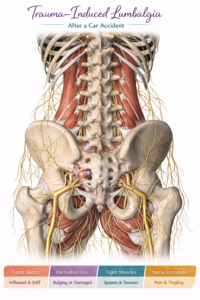
When someone experiences a car accident, the body is exposed to rapid acceleration–deceleration forces. Even when the impact happens at the front or side of the vehicle, the force travels through the spine, often concentrating at the lumbosacral junction (L5–S1) — the place where the flexible lumbar spine meets the stable sacrum.
This transition zone absorbs enormous mechanical stress, which is why lumbosacral pain is one of the most common injuries after motor vehicle accidents.
Structures Involved in Trauma-Induced Lumbosacral Pain
A holistic understanding recognizes that multiple tissues are usually involved simultaneously, not just one structure.
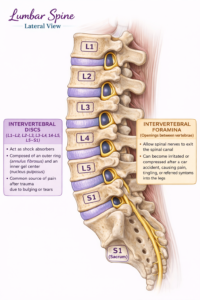 1. Intervertebral Discs
The lumbar discs act like shock absorbers between the vertebrae.
During sudden trauma they may experience:
• Annular micro-tears
• Disc bulging or herniation
• Increased intradiscal pressure
The L4-L5 and L5-S1 discs are the most commonly injured because they carry the greatest load.
Symptoms may include:
• Deep low back pain
• Pain radiating into the buttock or leg
• Sitting intolerance
2. Facet Joints
The lumbar facet joints guide spinal movement.
A car accident may cause:
• Facet joint compression
• Capsular ligament sprain
• Inflammation
Facet injuries often cause:
• Localized low back pain
• Pain with extension or twisting
• Muscle guarding
3. Ligaments
Ligaments stabilize the spine, and trauma can overstretch them.
Commonly affected:
• Iliolumbar ligament
• Anterior longitudinal ligament
• Posterior longitudinal ligament
• Sacroiliac ligaments
Ligament injury can create chronic instability and persistent inflammation.
4. Sacroiliac (SI) Joint
The SI joints connect the spine to the pelvis and transfer force into the legs.
Motor vehicle trauma may cause:
• SI joint irritation
• Pelvic torsion
• Ligament strain
Symptoms may include:
• Pain near the posterior superior iliac spine (PSIS)
• Pain when standing or walking
• Uneven pelvic mechanics
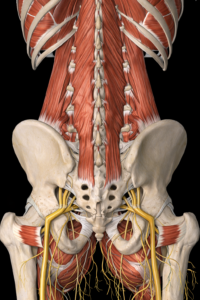 5. Muscles and Fascia
Protective muscle guarding often occurs after trauma.
Common muscles involved:
• Quadratus lumborum
• Multifidus
• Psoas
• Gluteal muscles
These muscles may develop:
• Trigger points
• Spasm
• Restricted mobility
6. Nerve Structures
The lumbar nerve roots and sciatic nerve can become irritated.
Possible symptoms:
• Radiating leg pain
• Numbness or tingling
• Weakness in the leg or foot
Even without disc herniation, inflammation and fascial tension can irritate nerves.
Nervous System Response to Trauma
After a car accident, the body may stay in a sympathetic “fight or flight” state.
This can lead to:
• Increased muscle tension
• Poor circulation to injured tissues
• Delayed healing
• Chronic pain patterns
This is why treating only the structural injury often isn’t enough.
A holistic approach addresses the nervous system, fascia, and biomechanics together.
Did you know?!!
After trauma, the body doesn’t just experience a mechanical injury — it experiences a whole-system event.
The spine, muscles, fascia, nerves, and nervous system all adapt to protect the body.
True healing often involves:
• Restoring structure
• Calming the nervous system
• Releasing fascial restrictions
• Re-educating movement patterns
When these systems are addressed together, the body can shift from protective tension → functional healing.
💡 Dr. Mary-style parent-friendly explanation
Think of the lumbosacral spine like the hinge between your upper body and your legs.
A car accident can jam that hinge.
If the hinge gets stuck:
• muscles tighten
• nerves get irritated
• the body guards the area
Holistic care helps unjam the hinge, calm the nervous system, and restore movement so the body can heal.
What would Dr. Mary do?
🌀 1. Nervous System Reset (First Always)
• Craniosacral therapy → sacrum + dural system
• Gentle touch to reduce guarding
• Shift body from fight/flight → healing mode
🦴 2. Joint + Structural Correction
• Chiropractic adjustments → L4–L5, L5–S1
• Sacroiliac (SI) joint balancing
• Restore lumbar-pelvic rhythm
💪 3. Muscle + Fascial Release
• Myofascial therapy → quadratus lumborum, psoas, erectors
• Trigger point work
• Release deep protective tension
⚡ 4. Targeted Tissue Healing
• Shockwave → chronic tight muscles + ligament strain
• Warm laser → inflammation + cellular repair
🔌 5. Nerve Decompression + Flow
• Reduce pressure around lumbar nerve roots
• Address sciatic pathway if involved
• Improve communication between brain ↔ body
🔄 6. Rebuild Stability + Movement
• Core activation → multifidus + deep stabilizers
• Pelvic alignment work
• Retrain safe, fluid movement
🌿 7. Reinforce Healing at Home
• Breathwork → downregulate nervous system
• Gentle mobility (not aggressive stretching early)
• Hypnotherapy / guided imagery → release stored tension